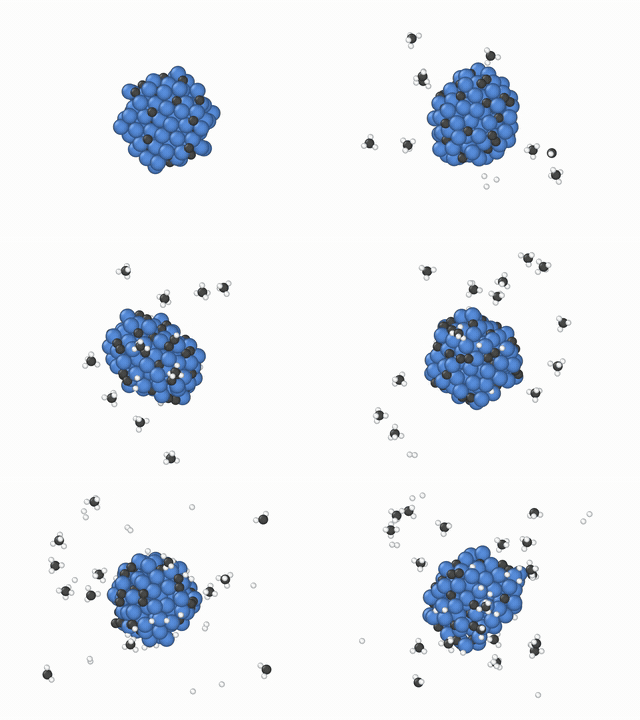
 Hydrogen is a promising energy carrier for sustainable energy technologies, but its production through conventional processes is often associated with significant CO₂ emissions. Methane catalytic cracking over metallic nanoparticles offers an alternative route, producing hydrogen and solid carbon without direct CO₂ formation.
We combine first-principles calculations and molecular dynamics simulations based on machine-learning interatomic potentials to investigate how nanoparticle composition, size and structure influence methane dissociation, hydrogen release and carbon nanotube (CNT) growth [112, 134].
Related project: STORMING
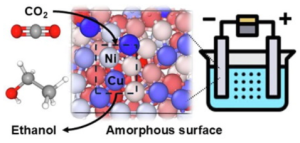 Electrochemical CO₂ reduction offers a promising route to convert carbon dioxide into valuable chemicals and fuels using renewable electricity. However, controlling the selectivity of electrocatalytic reactions remains challenging because competing reaction pathways and changes in the catalyst structure can strongly influence the resulting products.
Our recent studies on Cu-based catalysts, combining density functional theory with experimental investigations and machine-learning simulations, demonstrate how dopant chemistry and surface structure, including amorphization, influence CO₂ activation, reaction intermediate stability, and product selectivity [123,136].
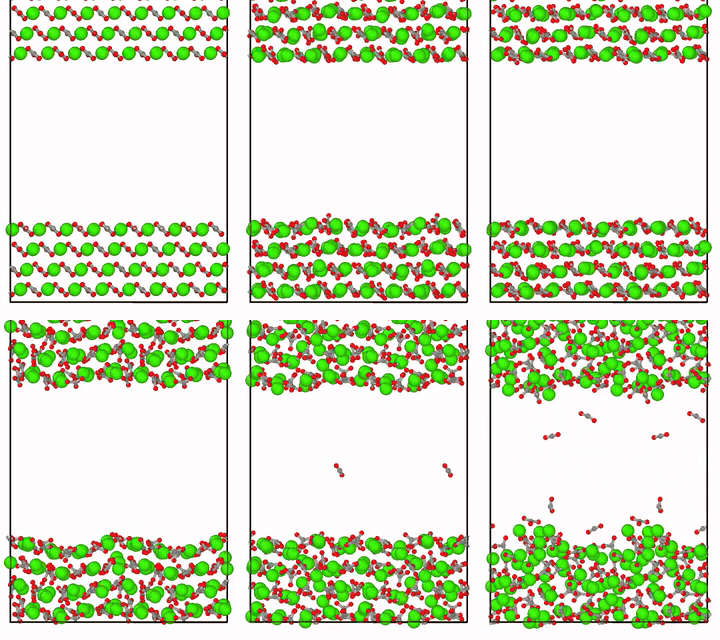 The thermal decomposition of calcium carbonate (CaCO₃) into calcium oxide and CO₂ is a fundamental process in lime and cement production, traditionally associated with high energy consumption and substantial carbon emissions. Improving the efficiency of calcination and developing alternative heating technologies are therefore important steps towards more sustainable industrial processes.
Our research focuses on understanding the atomistic mechanisms of CaCO₃ decomposition, including the reaction pathways, energy barriers and influence of different structural configurations and operating conditions. We combine first-principles calculations and molecular dynamics simulations based on machine-learning interatomic potentials to investigate CO₂ release and the structural evolution of calcium carbonate during calcination.
In parallel, we investigate the dielectric properties and microwave absorption mechanisms of carbonaceous materials, exploring how their structure, morphology and surface functionalisation influence their response to electromagnetic fields. Together, these activities provide microscopic insights into the processes underlying calcination and the potential role of carbonaceous additives in improving heating efficiency.
Related project: MOJITO